437. Path Sum III
2026/1/12大约 1 分钟约 358 字
437. Path Sum III
难度: Medium
题目描述
Given the root of a binary tree and an integer targetSum, return the number of paths where the sum of the values along the path equals targetSum.
The path does not need to start or end at the root or a leaf, but it must go downwards (i.e., traveling only from parent nodes to child nodes).
Example 1:
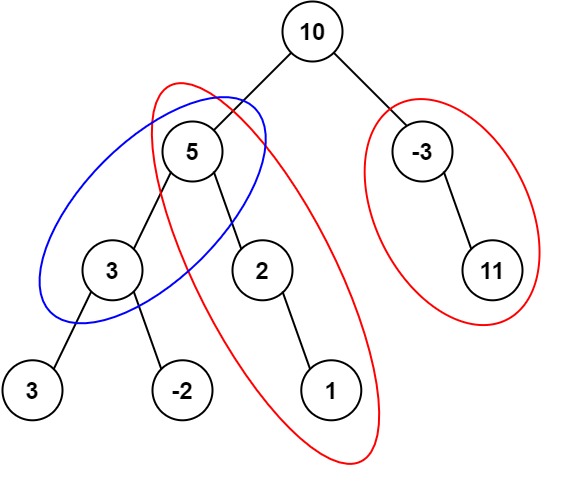
Input: root = [10,5,-3,3,2,null,11,3,-2,null,1], targetSum = 8
Output: 3
Explanation: The paths that sum to 8 are shown.
Example 2:
Input: root = [5,4,8,11,null,13,4,7,2,null,null,5,1], targetSum = 22
Output: 3
Constraints:
- The number of nodes in the tree is in the range
[0, 1000]. -109 <= Node.val <= 109-1000 <= targetSum <= 1000
解题思路
代码实现
解决方案
java
/**
 * Definition for a binary tree node.
 * public class TreeNode {
 *     int val;
 *     TreeNode left;
 *     TreeNode right;
 *     TreeNode() {}
 *     TreeNode(int val) { this.val = val; }
 *     TreeNode(int val, TreeNode left, TreeNode right) {
 *         this.val = val;
 *         this.left = left;
 *         this.right = right;
 *     }
 * }
 */
class Solution {
    public int pathSum(TreeNode root, int targetSum) {
        if (root == null) {
            return 0;
        }


        TreeNode left = root.left;
        TreeNode right = root.left;
        //包含root
        int ret = rootSum(root, targetSum);
        //不包含 root
        int uiLeft = pathSum(root.left, targetSum);
        int uiRight = pathSum(root.right, targetSum);

        return ret + uiLeft + uiRight;

    }

    public int rootSum(TreeNode root, long targetSum) {
        int ret = 0;

        if (root == null) {
            return 0;
        }
        int val = root.val;
        if (val == targetSum) {
            ret++;
        }

        ret += rootSum(root.left, targetSum - val);
        ret += rootSum(root.right, targetSum - val);
        return ret;
    }

}